Pages


Showing posts with label horses. Show all posts

5 Nov 2010

Fun Facts about Horses


  • There are about 75 million horses in the world.
  • Horses' hooves grow approximately 0.25 in a month, and take nearly a year to grow from the coronet band to the ground.
  • In the state of Arizona, it is illegal for cowboys to walk through a hotel lobby wearing their spurs
  • Cross-country jumps are marked with a red flag on the right side and a white flag on the left side; the horse has to jump through these two flags or it is considered out of bounds and you are disqualified.
  • A healthy adult horse should have a pulse of between 36 and 40 beats per minute while at rest
  • Arabians have one less rib, one less lumbar bone, and one or two fewer tail vertebrae than other horses.
  • Mr. Ed, the talking equine star of the 1960s television series, was a golden palomino. He learned an enormous amount of tricks for his role, including answering a telephone, opening doors, writing notes with a pencil, and unplugging a light. Apparently, Mr. Ed would occasionally have a fit of temper, as befitting his star status, and would stand stock still, wheezing and refusing to move.  
  • 7.1 million Americans are involved in the industry as horse owners, service providers, employees and volunteers. 3.6 million and 4.3 million of those participated in showing and recreation, respectively, with some overlap in cases of people who participate in both activities. 941,000 people participated in racing in either a professional or volunteer capacity. 1.9 million people own horses. In addition to the people actually involved in the industry, tens of millions more Americans participate as spectators.
  • The horse industry directly produces goods and services of $25.3 billion and has a total impact of $112.1 billion on U.S. gross domestic product. Racing, showing and recreation each contribute more than 25% to the total value of goods and services produced by the industry.                                                                                        
  • The industry's contribution to the U.S. GDP is greater than the motion picture services, railroad transportation, furniture and fixtures manufacturing and tobacco product manufacturing industries. It is only slightly smaller than the apparel and other textile products manufacturing industry.                                                                                      .
  • “If you want a kitten, start out by asking for a horse” -  Anon
  • “The horse is God's gift to man”. - Old Arab Proverb
  • “Show me your horse, and I will tell you who you are”. - Old English saying
  • "The one great precept and practice in using a horse is this, never deal with him when you are in a fit of passion." Xenophon, The Art Of Horsemanship, 400 BC
  • Adult respiratory rate is 8-16 breaths per minute
  • A horse typically sleeps two and half to three hours a day
  • Horses younger than 4 years can concentrate for a maximum of 10-15 minutes
  • Horses lie down only about 43.5 minutes a day
  • Horses sleep longer in the summer than in the winter
  • A horse’s heart weighs nine pounds
  • The horse is a herbivorous mammal
  • All horses (including zebras) belong to the genus equus
  • Horses began to evolve on the American continent over 60 million years ago, they later died out and were reintroduced by Spanish settlers
  • A zedonk is the offspring of a zebra and a donkey
  • No two horses are identical
  • The left side of a horse is called the “near side” and the right side is the “off side”
  • A horse has approximately 205 bones
  • A horse is described as a ‘foal’ for its first year of life
  • Foals have milk teeth, which are replaced by permanent teeth around 3-5 years old
  • A horse’s teeth can be used to estimate its age
  • Horses generally dislike the smell of pigs
  • A female horse is called a ‘filly’
  • Horses are traditionally measured in ‘hands’, this was originally the width of a man’s hand and has been set at 4 inches  


31 Oct 2010

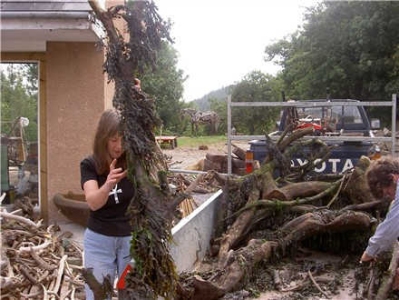
Horses made with three branches

tree-branch-sculpture (2)
They are beautiful sculptures made of three trunks. Views from afar are confused with real horses.
Step by step:


tree-branch-sculpture (11)

28 Oct 2010

Different Types of Horses and a game for you!!


To list all the different types of horses in one article is impossible, as it's an extensive one. There are over hundred different types of horse breeds in America, however, let us try and have a bird's eye view of the different horse breed types. Before heading into that, let's first understand that all horses belong to one family: Equidae and genus Equus caballus. This genus is further classified into various other breeds. Scientists have discovered that the earliest ancestor of the horse was an animal that was only 10-20 inches tall. However, nobody exactly knows when the first horse actually came into existence on this earth. Read more on interesting facts about horses.

Different Types of Horses

To simplify our understanding of how many different types of horses and ponies are present on this earth, we have categorized horses into different groups on the basis of common traits shared by them. Now, there is a stark difference between a breed and a type. A type encompasses several breeds of horses that share similar physical attributes.

Color Type
The first category we would be looking into, are horses that have been grouped together because of their unique coat colors and patterns. Palomino is one example of color type. This color type of horses are characterized by yellow, golden or tanned bodies with off-white or white manes and tails. Palomino horses refers to the color of the horse and not the breed, thus, palominos come in all kinds of breeds. These horses are considered to be multi-purposed horses favored for not only their beauty but also for their endurance and maneuverability. One can find these gorgeous horses in rodeos, parades, ranches, etc. Then there's the Appaloosa type, which feature either dark bodies with speckles, light bodies with dark spots or dark spots of white body. Then there's also the Pinto type which are horses with coat patterns, with large patches of white and any other color. Read more on pinto horse facts.


Light Horses
These are generally the types of horses for riding due to their swift and agile bodies. They can be used for various sport activities and entertainment purposes. Under these light horses come the Arabian horses, also known as Arab. These horses are one of the oldest horse breeds and is known for its beauty and elegance. It's highly treasured for its great speed, endurance, stamina and strength. Then there's the thoroughbred horse breed, which is mainly used for horse racing. These high spirited, fast runners have been used for human pleasure of riding. Then we have the Morgan breed, which are valued for their gentleness, soundness and intelligence. These wonderful driving horses are also great at dressage, jumping, endurance, reining and cutting competitions. The American Quarter horse and Standardbred breeds also come under this type of light horses, wherein the former is found in cattle ranches carrying out sport activities like roping, reigning, etc. while the latter are used as harness racers.

Draft Horses
This type entails large horses specifically bred for working on farms. These horses are characterized by strong, tall, muscular bodies with extremely gentle personalities. They are used for pulling heavy loads on the farm. Under this type we have breeds like Belgian horse breed, which is still used on farms due to its strength. However, it's more being used trail riding, gaming and show horses these days. Another breed under this type is the Clydesdale breed, which features large horses with feathery hair on their legs, just above the hooves.

Gaited Horses
Although these horses today appear in the show ring and are used mainly for trail riding, they were traditionally treasured and valued for the comfortable ride they gave their owners. These horses are known for their easy to ride, smooth and comfortable gaits. Under this type, comes the most popular riding horse called American Saddlebred, whose smooth style of walking and running has provided comfortable rides to its riders. These horses are not only a pleasure to trail ride, but are also capable of cutting well, jumping and is also an excellent competitor in dressage. The Campolina breed also comes under this type, which are used for leisure riding and driving, however, they are gaining popularity as suitable candidates for dressage. Some other breeds under this type are the Missouri Fox Trotter, Tennessee Walking horse, Mangalarga Marchador, Peruvian Paso, Walkaloosa, etc. Read more on horse riding.

Ponies
These are small horses with specific bone structure, musculature and temperament. As compared to the other types of horses, ponies exhibit thicker coat, mane and tails. Moreover, in appearance as well, they have shorter heads, shorter legs, wider barrels and thicker necks. Since they bear semblance to foals, oft people mistake ponies for young horses or foals. Their ability to travel in narrow mine shafts cause them to be used exclusively in coal mines. These intelligent animals can oft become stubborn, which is why they require proper training. The different breeds under this type are Shetland pony, Welsh pony, Connemara pony, Chincoteague pony, Dartmoor pony, Fell pony.


Feed the horse


Horse Population : How many horses are there? A game for you!!


There were 58,372,106 horses in the world in 2006 according to a study done by the Food and Agriculture Organization of the United Nations (FAOSTAT).
The United States came in at the top of their list, with 9.5 million horses.
The American Horse Council (AHC) did another study estimating the number of horses in the United States at 9.2 million.


Other countries with large populations include:
China - 7,402,450
Mexico - 6,260,000
Brazil - 5,787,249
Argentina - 3,655,000
Columbia - 2,533,621
Mongolia- 2,029,100
Ethiopia - 1,655,383
Russian Federation - 1,319,358
Kazakhstan - 1,163,500


The countries with the fewest horses were Malawi with 45, Grenada at 30, and Guam with 20. Rwanda and Saint Helena were the only two countries reported to have no horses.
In the United States, the states with the highest number of horses:
Texas - 978,822
: California - 698,345
Florida - 500,124
Oklahoma - 326,134
Kentucky - 320,173
Ohio - 306,898
Missouri - 281,255

Rhode Island with 3,509 and Washington DC with 33 came in with the lowest number of horses.


27 Oct 2010

Loving homes wanted for abused horses rescued from Buckinghamshire

Two years on from the terrible ordeal, new homes are now needed for the abusedhorses, donkeys and ponies that were rescued from the Buckinghamshire based horse trader.
Over 100 animals were found starved, dehydrated and seriously ill at Spindle Farm in Amshersham last year and the culprit, James Gray, was sentenced to a 26-week jail term when he was found guilty of animal welfare offenses alongside his wife and three children.

Seventeen of the 36 horses rehabilitated by the RSPCA are now fit and healthy enough to be re-homed. The other 20 will be available for re-homing soon.
The RSPCA has spent £2.3m in legal fees, veterinary bills and caring for the animals. The RSCPA animal centres across England and Wales are now looking after the 36 horses with Redwings Horse Sanctuary, World Horse Welfare and The Horse Trust are looking after the rest of the animals and are making separate arrangements for their care.
Sally Learoyd, RSPCA equine rehoming officer, said:
“These horses have been through a terrible ordeal and we need to find extra special permanent homes for them. We’re looking for patient, experienced owners who have the facilities, time, knowledge and money needed to care for the horses for the rest of their lives. They are mostly youngsters so potential adopters will need to be able to offer a long-term commitment.”
Anyone wishing to give the horses a home should download an application form atwww.rspca.org.uk/amersham or call 0300 123 8000.